Hair loss often shows up quietly. One morning the part looks a little wider. Another time, maybe under harsh overhead lighting you didn’t choose, the hairline just seems thinner than before. At first, it’s easy to second-guess yourself. For many people dealing with early to moderate androgenetic alopecia, that moment brings stress, confusion, and plenty of late-night searching. People want answers, but hormones or daily pills, and the side effects that often come with them, don’t appeal to everyone. That hesitation helps explain why topical hair regrowth options have been getting more attention lately, quietly and faster than many expected.
Topical hair regrowth treatments are applied directly to the scalp. They’re designed to work on the follicles themselves, right where thinning usually begins, instead of moving through the whole body. It’s a simple idea. What’s changed is the science behind it. In recent years, research has gone beyond just slowing hair shedding. The focus is now on reactivating dormant follicles and supporting them with better blood flow, nutrients, and growth signals so they can start producing hair again, right from the root.
In this guide, we’ll look at newer topical hair regrowth approaches and how effective they usually are. There’s no fluff here, because results are what matter. We’ll review familiar treatments alongside newer non-hormonal options, using clinical trial data. Some will sound familiar; others probably won’t. PP405, a topical treatment getting attention for its stem cell-focused approach, is included as well, along with why researchers are watching it closely.
Why Topical Hair Regrowth Is the Focus of Modern Hair Loss Treatment
Topical hair regrowth is at the heart of today’s hair loss market, and that usually makes sense once people look at how it fits into everyday life. Nearly 90% of hair loss products used today are topical. Many people choose them because they feel safer and are easier to keep using, especially with a busy schedule. Instead of affecting the whole body, these products are applied directly to thinning areas of the scalp, and they can be stopped at any time. Having that level of control often helps reduce stress, which matters when a treatment takes time to show results.
The global hair regrowth market reached about USD 7.8 billion in 2025 and is expected to more than double by 2035. Most of that growth comes from topical treatments. This shift points to changing expectations. People want better results, fewer side effects, and proof backed by real science instead of bold marketing claims. In my view, that’s a good change.
Here’s a quick snapshot of how the current market looks. Just the basics, nothing fancy.
| Metric | Value | Year |
|---|---|---|
| Global hair regrowth market size | USD 7.8 billion | 2025 |
| Projected market size | USD 16.9 billion | 2035 |
| Share of topical treatments | 91.6% | 2025 |
| Scalp hair loss focus | 72.1% of treatments | 2025 |
Traditional topical options like minoxidil showed that scalp-applied treatments can work, but they also showed clear limits. Results can take months, progress may slow down, and some users deal with irritation or shedding. These issues pushed researchers to look for new approaches using better data and a deeper understanding of biology. Progress isn’t fast, but it’s still moving forward.
From Maintenance to Regeneration: How New Topicals Are Different
For a long time, topical hair loss treatments have mostly been about defense. They usually try to help the hairs you already have stay put a bit longer. By slowing shedding at the scalp surface, individual strands can last longer, which often means thinning moves more slowly. Real reversal, though, doesn’t happen often. In my view, it’s usually been more about holding ground than making a true comeback.
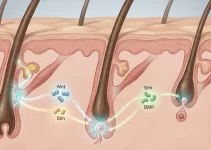
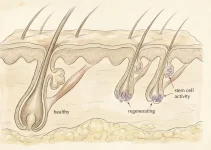
What’s more interesting is how newer topical hair regrowth treatments are changing that goal. Instead of focusing only on the hair shaft, they look deeper and target the follicle itself, where hair growth actually starts. Research suggests that many follicles affected by androgenetic alopecia aren’t gone forever. They’re often dormant. These follicles still have stem cells, but those cells are inactive and barely doing anything, quiet, not dead. That difference matters more than it might seem.
Because of this, researchers are exploring ways to restart activity inside the follicle. Some approaches adjust metabolic pathways, turning cell energy and signaling back on. Others work by blocking the signals that keep stem cells “asleep” in the first place. Shifting away from basic hormone control toward regeneration changes how treatments are designed. It’s a different, and more ambitious, approach.
This gap is easy to see with current benchmarks. With 5% topical minoxidil, about 62% of men see some regrowth after one year. That’s real progress. But a large group still sees little visible change, which can be frustrating if you’re one of them. That’s the area newer topicals are trying to improve.
If you want a closer comparison of different options, we covered that here: Topical Hair Regrowth Treatments: Effectiveness Compared.
PP405 and the Rise of Stem Cell-Targeted Topical Therapy
What’s getting attention with PP405 isn’t just that it’s another hair regrowth topical, but how it works. Instead of affecting hormones, it targets dormant hair follicle stem cells. That difference often matters in everyday use. The idea is to push those follicles back into a normal growth cycle without triggering wider changes in the body. In my view, that tighter focus likely explains why interest has grown so quickly.
The clinical data helps explain the buzz. In a Phase 2a trial, men and women with androgenetic alopecia applied PP405 once a day as a topical gel. What stood out wasn’t only that people improved, but how large the gap was. About 31% of men using PP405 saw hair density increase by more than 20%, while no one in the placebo group reached that level. For people who have already tried other options, that kind of difference is hard to ignore.
Timing also comes up a lot in conversations. Early regrowth showed up in around eight weeks, which is faster than most standard treatments. Researchers also reported no detectable systemic absorption. That point often reassures people who want to avoid hormone-related effects. In practice, PP405 comes across as a non-hormonal topical with a focused, local effect.
Here is a simple breakdown of the PP405 trial results.
| Trial Detail | Result |
|---|---|
| Trial phase | Phase 2a |
| Participants | 78 men and women |
| Application | Once-daily topical gel |
| High-density response | 31% achieved over 20% increase |
| Systemic absorption | None detected |
Application Matters: Getting the Most From Topical Hair Loss Treatments
It’s easy to fixate on formulas and brand names, but even the most advanced topical hair regrowth treatment can fall short if it’s applied the wrong way. How you use it often shapes results more than people think, sometimes even more than what’s on the label. The product also isn’t doing all the work by itself. Consistency, scalp health, and patience all factor in, especially when patience feels like the toughest part.
Most topical treatments work best on a clean, dry scalp. Oils or heavy styling buildup can slow absorption, which doesn’t help if you’re aiming for progress. “Clean and dry” usually means applying after washing, once hair has fully air‑ or towel‑dried. Many people find it helpful to connect application to a daily habit, like an evening shower or bedtime. Keeping the timing steady often makes the routine easier to stick with, even if it feels repetitive.
Stopping too early is a common source of frustration. Many treatments take months, not weeks, before changes appear. Some early shedding can happen as older hairs fall out to make room for new growth. It can feel worrying, but it’s often part of the process.
Newer options like PP405 aim to reduce the waiting period, but regular use still matters. Missed days or frequent changes can lead to uneven results, like skipping applications during a busy week and later noticing thinner patches.
We covered real-world routines and step-by-step habits in more detail here: Topical Hair Regrowth Treatment Protocols: Best Practices.
Safety, Side Effects, and Non-Hormonal Peace of Mind
Side effects are often why people start looking past hormonal hair loss treatments. That worry is usually reasonable. Oral options can affect hormones throughout the whole body, not just the scalp, and for some people this shows up as changes in mood or sexual health. The hard part is that these effects can feel random, which can add even more stress.
Topical hair regrowth treatments usually come with fewer risks, though they aren’t perfect. People often mention scalp redness, itching, dryness, or a brief shedding phase. These reactions are typically mild, stay on the scalp, and often ease as the skin gets used to the treatment.
Newer options like PP405 stand out because safety was considered from the beginning. Clinical testing looked closely at whether it enters the bloodstream and didn’t find any, which the brand sees as especially helpful for women and for those sensitive to hormone changes.
Knowing about side effects ahead of time can help set realistic expectations. For instance, someone comparing treatments might start here: Side Effects of Non-Hormonal Hair Loss Treatments and also review Side Effects of Emerging Hair Regrowth Treatments: What to Expect.
Cost, Access, and the Future of Topical Hair Regrowth
As topical hair regrowth treatments keep improving, cost and access often shape everyday decisions, especially for people paying out of pocket. Traditional options are easy to buy online or at local pharmacies and usually stay affordable. They also haven’t changed much over the years, with few real updates, which can start to feel repetitive for long‑term users. Newer therapies, by contrast, often come with higher prices and limited access, since many first appear in clinical trials instead of on store shelves. This gap strongly influences real‑world choices.
PP405 is still in the research and approval stage, so access remains limited, with no casual purchasing yet. Timing matters here. For some people, joining a clinical trial is the main way to try next‑generation regrowth early, while also helping move the research along. Those interested in trial participation can check Guidelines for Participating in Clinical Trials for Hair Loss Treatments for more details.
Experts expect more regenerative topicals to enter trials over the next few years. Many will focus on stem cell activation and improved delivery methods aimed at quicker visible results. As competition grows, prices may slowly come down and access could widen over time.
Balancing cost with possible benefits helps with planning. Some people stick with proven options while casually following updates. Others choose to wait for non‑hormonal options that feel like a better personal fit, in my view. You can explore more on this topic in Cost Analysis of New Non-Hormonal Hair Regrowth Treatments: Is It Worth It?.
The Bottom Line on Innovative Topical Hair Regrowth
Hair loss is personal, often more than people expect. There isn’t one right answer for everyone, and most people notice that pretty quickly (you probably have, too). What’s clear now is how much stronger the science behind topical hair regrowth has become. In many cases, follicles aren’t actually gone. They’re often inactive, waiting for the right signal, which can feel encouraging in this situation.
What’s interesting is the move away from only trying to slow loss. Traditional treatments did useful work and showed what could be done. Newer non-hormonal options build on that base, using biology that often makes more sense and safety profiles that tend to feel easier to stick with over time. PP405 is a good example of how focusing on regrowth, not just upkeep, can shift the direction.
For people with early to moderate androgenetic alopecia, staying informed usually helps. It’s worth looking at how treatments work and paying attention to clinical trial data, not just headlines. The next step might be a small change to a routine, or simply keeping an eye on how something like PP405 develops. That kind of understanding often brings a sense of control, knowing why you’re choosing what you’re choosing.