The search for effective hair regrowth treatment options has become a core focus for both patients and researchers.
Hair loss can feel very personal. For many people dealing with early to moderate androgenetic alopecia, it goes beyond looks, which still surprises some folks. It often ties into confidence and that feeling of staying in control of what’s happening.
That part is deeply personal. For a long time, choices felt limited. Some treatments worked by changing hormones, while others took a long time and gave results that were hard to predict, which can be frustrating.
As 2026 gets closer, topical hair regrowth treatment is entering a new phase. Instead of only slowing hair loss, research is now looking at ways to wake up dormant follicles and help them return to active growth.
This change matters because these 2026 developments come from clinical research, not marketing claims, and that usually makes a real difference. The focus is targeted scalp treatment without changing hormones across the whole body, something many people prefer.
So what’s actually ahead? This article looks at new non-hormonal topicals, touches on regenerative science, and examines what this could mean for everyday use, like applying treatments in real life. There’s no hype here. If evidence, safety, and results that can last matter to you, this will likely feel relevant.
Why Non-Hormonal Topical Hair Regrowth Treatment is the Focus Now
What people are noticing lately is the direction new hair regrowth products are taking. Many now work right at the follicle instead of changing hormone levels throughout the body. For a lot of people, that makes long-term use feel easier to stick with.
This is especially true when thinning has just started and people are still figuring out what feels okay to use every day.
Interest in non-hormonal hair regrowth treatments has grown quickly over the past few years, and there’s a clear reason for that.
Many people want to avoid the body-wide side effects linked to oral medications. That concern often comes up early with androgenetic alopecia, when the goal is to protect existing follicles and help them stay active before hair loss becomes permanent.
In my experience, this early stage, when thinning first becomes noticeable, is often when people are most open to trying something gentler.
Market data helps explain the shift. Around 50 million men and 30 million women in the U.S. are affected, and the global market is expected to more than double by 2034. Much of this growth seems tied to options that feel safer and more targeted, especially treatments used directly on the scalp instead of the whole body.
| Metric | Value | Timeframe |
|---|---|---|
| U.S. adults affected by androgenetic alopecia | ~80 million | Current |
| Global market size | USD 3.51 billion | 2025 |
| Projected global market size | USD 7.31 billion | 2034 |
Dermatologists also see better follow-through, mostly because these treatments feel lower risk and easier to live with, like something that naturally fits into a daily routine.
Stem Cell Reactivation: A New Way to Think About Hair Regrowth Treatment
As we head toward 2026, one of the more interesting shifts in hair research focuses on follicle stem cell reactivation. For years, thinning follicles were seen as a dead end.
The general view was that once they slowed down, they were more or less gone for good. Newer research paints a different picture. Many follicles are still present but sitting idle, often far less active than expected. In most cases, they haven’t vanished, they’re just switched off.
This idea is the basis for topical treatments like PP405. Instead of forcing hair to grow, these formulas aim to signal resting stem cells to move back into a growth phase. People often describe it as a gentle nudge rather than a push. That matters because older treatments mainly focused on protecting hair that was already growing and didn’t do much for inactive follicles.
The exciting value to PP405 is that it appears to induce or stimulate dormant hair follicles into the anagen phase of the hair cycle, suggesting the potential for regeneration.
Early clinical trials suggest this method may improve hair density without hormone suppression.
For people with early to moderate androgenetic alopecia, that can make a real difference. The follicles are still there, and results depend on giving them the right signal at the right time, usually before shrinkage goes too far. Researchers watch timing closely, since response tends to drop as miniaturization continues.
This type of topical regrowth treatment is still being reviewed. Phase 2 results have boosted confidence so far, and Phase 3 studies expected around 2026 should give a clearer view of long-term results and how well it works with standard treatments, which is where it starts to feel truly useful.
Exosomes and Regenerative Signals at the Scalp Level
Exosome-based topical therapy has been getting a lot of interest lately, mostly because it works at the signalling level instead of just on the surface. Exosomes are tiny messengers released by cells, small, but very active.
They carry growth factors and other signals that help guide how tissue repairs itself over time. In hair regrowth treatment research, scientists are exploring how these signals may support follicle health right at the scalp and help keep growth cycles on track by gently pushing follicles during their active phases.
It’s a pretty straightforward idea, but one with clear potential benefits.
Some early regenerative trials using stem-cell signalling have reported hair density increases in the 25 to 40 percent range. That’s encouraging, even though the studies are still small, so most researchers stay cautious.
Many also find topical delivery often works better when combined with scalp methods that help products reach deeper layers. Micro needling is mentioned often, and simple massage is tested too.
| Regenerative Approach | Observed Outcome | Study Stage |
|---|---|---|
| Stem cell signalling topicals | 25, 40% density improvement | Early clinical trials |
| Exosome-enhanced protocols | Improved follicle activity | Pilot studies |
We have shown that the isolated cells are capable to improve the hair density in patients affected by androgenetic alopecia.
Clearer rules around formulation and safety are expected by 2026.
This matters because exosomes sit in a gray area, closer to medical treatments than standard cosmetics in how they work. Clear oversight can protect patients and help build trust as more clinics and topical brands move into this space, step by step.
Peptides, Wnt Pathways, and Smarter Topical Design
New ideas in hair regrowth treatment aren’t just focused on stem cells anymore. Peptides and pathway modulators are now shaping where treatments are going, which makes sense given how much cell signalling affects hair behavior.
These small molecules work on signals that guide the hair growth cycle, with a lot of attention on the Wnt pathway and how it changes over time. They send steady, subtle messages rather than dramatic ones. That’s likely why researchers keep coming back to them instead of chasing louder, trend-driven targets.
What really stands out is precision. Instead of pushing the whole scalp at once, these topicals are designed to work during the growth phase and focus on areas that are actually thinning, not everywhere by default.
The aim is to gently encourage follicles to grow while avoiding irritation or extra stimulation, which most people prefer. To make this work on real skin, many formulas use delivery systems like liposomes and nanocarriers. These help ingredients stay stable and reach the right spot more reliably. It’s about timing, not force.
There are still common mistakes. Using too much product or mixing treatments without clear guidance often causes problems. Some people also expect changes in a few weeks, but that rarely happens. Most data shows slow progress, with early changes around three to six months and clearer results closer to a year. Waiting it out usually helps.
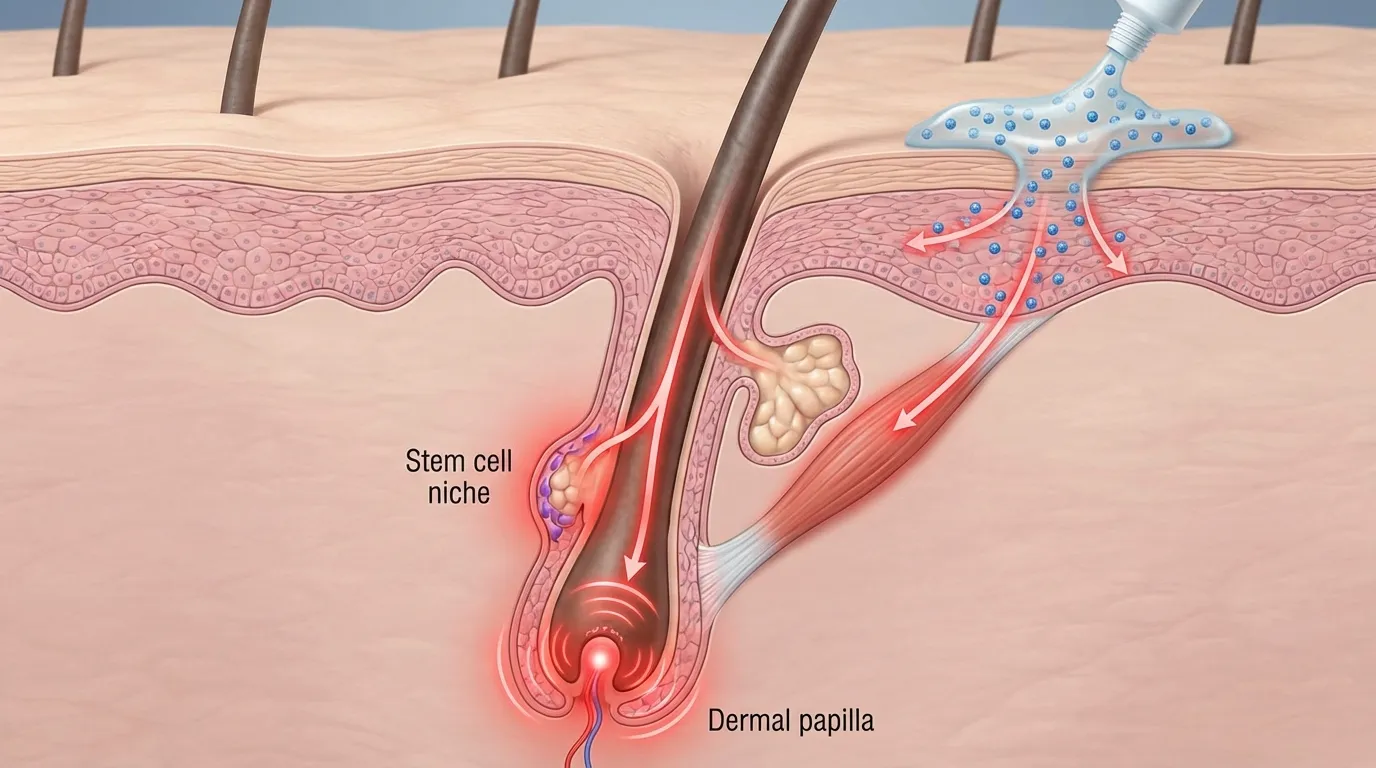
Topical hair regrowth treatment science visualization
Dr. Antonella Tosti points out that upcoming treatments will likely combine topical delivery with regenerative signals, instead of relying only on hormone control. This matches current research and helps explain why 2026 is getting attention from people who want options that work with the body and feel gentler overall.
Localized Anti-Androgens With Lower Systemic Risk
Many people look for non-hormonal options, which makes sense. At the same time, localized anti-androgens are moving forward, often faster than most people expect.
Topical finasteride is made to work mainly on the scalp, not the whole body, and that focused action is usually the main draw. Phase III data shows hair count gains close to oral versions, while much lower amounts reach the bloodstream, which often helps lower concern rather than remove it completely.
For some patients, this works as a middle step instead of a big jump, more like testing things out first. It keeps treatment where it’s needed and often eases worries about whole-body side effects. Still, it won’t work for everyone. In my view, it’s especially useful for people who stopped oral therapy because it was hard to handle.
Supervision still matters a lot. Even topical treatments should be used with medical guidance. By 2026, clearer dosing rules and smarter combinations are expected to make treatment safer and help clinicians adjust plans more easily, something patients will likely notice during follow-ups.
Putting the Pieces Together for 2026 and Beyond
Looking ahead to 2026, what stands out is how current hair loss research is moving toward smarter science that fits how hair biology actually works. Instead of pushing against natural cycles, studies now work with them. Regenerative signals, stem cell activation, peptides, and better delivery systems are often treated as one connected system, which feels more realistic than older methods.
For people with early to moderate androgenetic alopecia, the outlook remains cautiously optimistic. Hope helps, but data usually matters more. Clinical trials are worth watching closely, especially when results go beyond bold headlines.
A helpful approach is to look at non-hormonal options with published outcomes, then combine treatments carefully. Without professional guidance, slow and steady steps often lead to better consistency.
And what about newer developments like PP405 hair regrowth treatment? If progress continues, 2026 may bring options focused on regrowth instead of only slowing loss, a shift that fits restoring natural growth patterns first. Ultimately, the evolving science behind hair regrowth treatment suggests that 2026 could redefine how we think about follicle recovery and long-term scalp health.